Math Story Books for Children - Great for Homeschool families
A terrific way for homeschooling families to enjoy math is to read math story books together. Not only is it enjoyable and interesting, it is also a great way to develop mathematical vocabulary in the context of a story. Once the story book (or a part of it) has been read, ask your child to tell you what it was about. Then, the child will need to use the same mathematical language to describe and explain the concept.
Many story books for young children are not written specifically as a Math story book, but still contain mathematical vocabulary. Fun books such as Hop on Pop by Dr. Seuss The Foot Book Green Eggs and Ham and many others are filled with mathematical language describing location and size- on, in, up, on top, inside, left, right, tall, short, big, small, tiny and so on.
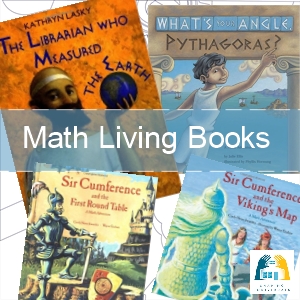
Another great series mostly for primary children is the Sir Cumference and the First Round Table and others by Cindy Neuschwander help to explain spatial and geometric concepts in an exciting math adventure.
For the older children, I love the biographies of mathematicians as found in the Champions of Math and also the Exploring The World Of Mathematics.
Enjoy these Math story books!
Math Story Books by Jeanne Bendick
 
|
Along Came Galileo Galileo changed the way that we see our world by asking question after question. This easy-to-read biography looks at Galileo's life, including his testing of data and discovery of new theories. 95 indexed pages, softcover with illustrations. |
 
|
Archimedes and the Door of Science Imagine a biography, a study of mathematical and scientific concepts, and an overview of the culture of ancient Greece---all rolled into one! Students will love reading this personal account of Archimedes---one of the greatest minds of the ancient world. They'll discover, like Archimedes, the excitement of ideas and learning! Simple illustrations enhance the accessible text. Ages 10 and up. 142 pages, softcover from Bethlehem Books. |
Sir Cumference Math Story Book Series
 
|
Sir Cumference and the Dragon of Pi, A Math Adventure Sir Cumference, Lady Di of Ameter and Radius are back in their second Math Adventure! This time, a potion has changed Sir Cumference into a fire-breathing dragon. Can Radius change him back? Join Radius on his quest through the castle to solve a riddle that will reveal the cure. It lies in discovering the magic number that is the same for all circles. Recommended for grades 2 to 4. |


More Math Story Books by Cindy Neuschwander


Other Math Story Books
 
|
A Place for Zero: A Math Adventure Sometimes you have to take risks to really count. Zero is all alone in the land of Digitaria. He can't play addemup with the other numbers, because he has nothing to add. Join Zero as he goes on a journey to discover his place. His quest takes him from the mysterious workshop of Count infinity to the palace of King Multiplus, where Zero meets a stranger who looks surprisingly familiar. Recommended for ages 5 to 9. |
 
|
What's Your Angle, Pythagoras? Young Pythagoras can't seem to stay out of trouble. Every time he tries to help, people get angry. What's a curious kid to do?On a trip to Egypt, Pythagoras' curiosity helps him discover the secret of the right triangle. A clever introduction to the Pythagorean Theorem. |
 
|
The Fly on the Ceiling - A Math Reader Recognized as the father of analytic geometry, Rene Descartes was a French mathematician and philosopher. Kids will love this funny and very accessible tale - based on one of math's greatest myths - about the man who popularized the Cartesion system of coordinates. |
Math Living Books for Older Children
 
|
Exploring The World Of Mathematics Show your students that numbers don't have to be difficult---in fact, they can be enjoyable! More than just another textbook, this supplement to your curriculum traces the history of mathematics principles and theory; features simple algebra, geometry, and scientific computations; and offers practical tips for everyday math use. Includes biblical examples, fun activities, chapter tests, and lots of illustrations and diagrams. Age 10 and up. |
 
|
Champions of Math The great minds of the past are still with us today in many ways. Individuals who explored the natural world hundreds and thousands of years ago have given us a treasure of knowledge in all the sciences. In this exciting series from educator/author John Hudson Tiner, short biographies of the world's most gifted thinkers will inspire the leaders of tomorrow. Learn how Pythgoras investigated mathematics through his affinity for music. Marvel at the "new math" Leonardo Fibonacci learned from the Moors in North Africa. These valuable learning guides will give students accurate accounts of lives from the annals of science, and explain what those scientists believed about the world around them. |
Where to from here?



Schoolhouse Teachers
Schoolhouse Teachers Art Courses