Charlotte Mason Curriculum for History
"Give them the right books!"
What does a Charlotte Mason Curriculum for history look like? Here you will find the Charlotte Mason History Curriculum from her own volumes - and also a way in which you can design your history curriculum in a Charlotte Mason style, building a CM history curriculum, incorporating living books and the use of a Book of Centuries - Charlotte Mason's timeline idea.
Charlotte Mason: The Importance of Teaching History
When describing her Charlotte Mason Curriculum in History, Charlotte Mason says, "It is necessary to know something of what has gone before in order to think justly of what is occurring to-day."
Speaking of the defect in school curricula which fail to give a comprehensive, intelligent and interesting introduction to history, Charlotte Mason says, " It is never too late to mend but we may not delay to offer such a liberal and generous diet of History to every child in the country as shall give weight to his decisions, consideration to his actions and stability to his conduct; that stability, the lack of which has plunged us into many a stormy sea of unrest."
Charlotte Mason Curriculum: How to Teach History
The method that Charlotte Mason is advocating in the study of history is to "give them the right books."
"We are aware that our own discursive talk is usually a waste of time and a strain on the scholars' attention, so we (of the P.N.E.U) confine ourselves to affording two things- knowledge, and a a keen sympathy in the interest roused by that knowledge. It is our part to see that every child knows and can tell, whether by way of oral narrative or written essay......A single reading is a condition insisted upon..." (p171)
The "Knowledge of Man" Charlotte Mason Curriculum
Below is a list of Charlotte Mason Curriculum for History: "Knowledge of Man" from her own writings and then suggestions on how to design your own Charlotte Mason History Curriculum for Years 1-6 and Years 7-12
- Years 1-6 Charlotte Mason Curriculum
- Suggestions to design your History Curriculum for Years 1-6
- Living Book Suggestions
- Years 7-12 Charlotte Mason Curriculum
- Suggestions to desing your History curriculum for Years 7-12
Charlotte Mason History Curriculum Years 1-6 |
| "Age 6- not stories from English History, but a definite quantity of consecutive reading, say, forty pages in a term, from a well-written, well-considered, large volume which is also well-illustrated." The book is, Our Island Story by Mrs. Marshall. The teacher will read " and the children will 'tell' paragraph by paragraph, passage by passage." This is to encourage mind memory,in which the mind is active remembering, rather than word memory which focuses on repetition. Age 7-8 continue with Our Island Story to the end of the book, reading approximately 40 pages a term, and employing the same methods of a single reading, followed by oral or written narrations. The history is "amplified and illustrated by short biographies of persons connected with the period studied." This way the children individualize their heroes and patriotism is inculculated. Ages 9-12 - "A more difficult book than 1A, an interesting and well-written history of England of which they read some fifty pages or so a term." Also, they read some chapters in a book which describe the social life in England at the time. The children are also introduced to contemporary history of other countries, "as the study of English history alone is apt to lead to a certain insular and arrogant habit of mind." These children read relevant chapters from First History of France alongside the English history. Reading history in this way "throws light on that of their own country and certainly gives them a sense that history was progressing everywhere much as it was at home during the period they are reading about." Ancient History which cannot be contemporaneous, is approached in a chronological way through a book about the British Museum by Mrs.W.Epps. "A "Book of Centuries" in which children draw such illustrations as they come across of objects of domestic use, of art, etc, connected with the century they are reading about. These books - on English History, French History and the British Museum book are used through these years, going on with their "Book of Centuries" and adding a little book on Indian History (20-30 pages a term) at about age 12-13. |
Design Your Charlotte Mason Curriculum - History
Let us note how Charlotte Mason taught history:
- Used a Chapter Book as a Spinebook;
- Worked chronologically;
- Read short biographies of persons connected with the period studied;
- Used literature from ages 7-8 onwards which linked to history;
- Used a "Book of Centuries" from ages 9-12.
Charlotte Mason's Methods in teaching history
1. Charlotte Mason and the use of a History Spinebook
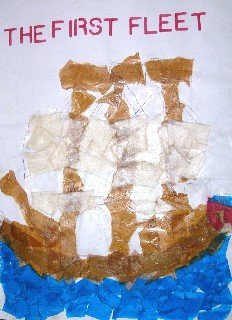
Charlotte Mason chose spine books to read the history of England, France, the Indians, the Greeks and Romans. A Spinebook is a book which can be used to tie the stories together. It would not be a dry, dull book. It would be an inspiring book which captures the child's interest attention and tells the exciting stories of the "big" and "small" characters of history.
This book must be chosen carefully. Remember the words on Charlotte Mason, "well-written, well-considered, which is also well-illustrated." We must give them, "the right books."
In the Charlotte Mason curriculum, the teacher would read the Spinebook and the child would narrate orally or in a written essay. The section covered in the spinebook can be explored in further detail to gain further insight into the time period and what is happening in other parts of the world at that time.
There are many other home school ideas which could be incorporated into your history study after reading the history spinebook. You could read historical fiction novels, act out plays, dress up, prepare feasts, give speeches about the topic/person/event which bring the time period alive. Excursions to museums or memorial sites can enhance the history readings.
Although Charlotte Mason does not refer to history projects, this can also be a way to enhance the reading. When ready, head back to the spinebook to continue through the study of the time period. Charlotte Mason was very concerned about not giving children "twaddle". Sometimes even a project can be "twaddle" and fiddling around, rather than filling the child's mind with living ideas.
For more information go to Using a Spinebook to Teach History.
2. Develop a chronological approach to teaching homeschool history
If you are homeschooling one child, you would move chronologically through history using a Spinebook if desired and choose literature which suits the age level of your child. You would move through history in two cycles, Years 1-6 and then begin again in Years 7-12 in greater depth.
However, if you are homeschooling more than one child you need to decide
- Will each child study a different time period? - using a Spinebook, literature selection you have chosen - reading and narrating. OR
- Will your family study the same time period? - using a spinebook (to cover most ages) and then choosing literature which is appropriate for each age.
Once you have decided this question, you can go on to select books which would serve your purpose. See History Using a Chronological Approach for more information.
3. Use biographies in designing the Charlotte Mason styled History Curriculum
Although a History spinebook or Chapter Book helps to keep you on track, it must not be the only source of reading. If our History reading had only consisted of reading from a spinebook (no matter how good you may consider that book), it would not have captivated my children and given them a love of history. When one reads biographies and stories of real events, real people, real emotions, the children can place themselves in a time period and experience the joy, difficulties and sorrows of the characters. Reading biographies can help your children live out the time period. The Famous Men books (Famous Men of Greece, Rome, Middle Ages and so on) contain short biographies, or you can read novels on time period characters (The Trailblazer Series for example.)
4. Use excellent literature when designing a History curriculum
The key to designing your own history curriculum is to read exciting, time-period novels with your children, either as read-alouds or as assigned readings.
Although Charlotte Mason would advocate that when the child can read, they should be reading mostly on their own, I would not give away my time-slot of reading to my children. The truth for me is that if I am not engaged in reading history to my children, I am missing out on enjoying the history experience with them. Reading alongside my children, has been my second chance at my own education.
In A Living Books Approach to History I have described ways to use Living Books to teach History.
5. Make a "Book of the Centuries" as a part of your homeschool history curriculum
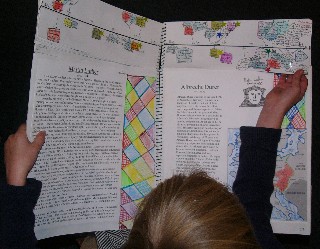
A Book of Centuries is a way in which information about history - the people, places, events can be recorded. This is an excellent way to add in the Charlotte Mason timeline idea and what Charlotte Mason terms, "Book of Centuries."
You can either purchase a pre-made Book of Centuries or make your own.
We have made our own History Books using A3 visual arts diaries. For my younger children, we entered the narrations in chronological order as we read the stories, and added pictures and dates. However, for my older children (beginning age 12-13), we wanted to include a time-line. This presented us with a problem. We needed to work out how many years to place on each double-page. If we spanned 50 years a page, what would happen if our writings were greater than the allocated amount of space we provided?
As we spoke about this together, we came up with the solution of dividing and cutting the pages, to make a time-line at the top of the page, which could be turned separately. Now, the children can turn to their written narration on World War I, and turn their time-line strip to the same section.
This has seemed to work for us and their books are a wonderful reminder of what we read and studied together through the years.
Adding a history notebook or timeline is a great way to enrich your own Charlotte Mason curriculum
Timeline figures and 'Record of Time' Notebook
If you're hoping to set up your own history notebooks - take a look at what Amy Pak offers with the History Through the Ages timeline figures. Also available is the history, "Record of Time" notebook to record and create your own wonderful book of history! Really helpful resource and can be used with any homeschool history curriculum.
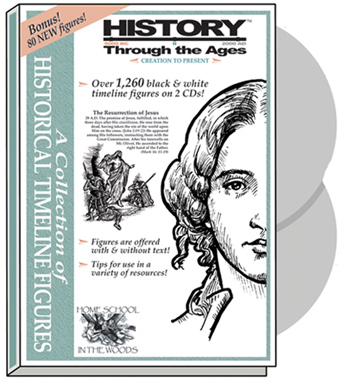
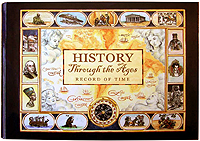
HISTORY Through the Ages Collection of Historical Timeline Figures on CD
This 2-CD set allows the freedom to print timeline figures in a variety of ways and sizes, to suit whatever project you're working on!
- 1,260+ total figures, including 80 BONUS FIGURES!
- Both CDs contain figures in two formats: One with text descriptions for those who prefer an encapsulated summary, and one with only a name and date, allowing the child to add in the information, or for easier use in projects.
History Through the Ages- Record of Time Notebook
With all the time and energy your child puts into their timeline notebook, you will want one that not only beautifully displays their efforts, but will stand up to the years of use, providing a keepsake to last their school-life and beyond. We designed the Record of Time with all those elements in mind!
Homeschool History Living Book Suggestions
When designing your own history curriculum, the main thing you would want to have is an excellent list of books and then work your way through them as you study the different periods. have collated my favourite history living books into time-periods.
Each time-period is then divided into
- Spinebooks,
- Read Alouds,
- Historical Fiction Living Books,
- Teacher Resource Books,
- Hands on History Project Ideas
Although it is difficult to divide living books into age-appropriate levels (you may have a more sensitive or more mature child - your choice, remember), I have divided them into age levels : Years 1-4; Years 5-8; Years 9-12.
I hope you enjoy these books and that they may bring your study of history alive and exciting and that you may enjoy living in the past and learning from it.
Living Books in the historical time periods

My TOP TEN (short list) History Living Books Suggestions:
- Ancient Egypt, Greece, Rome, Medieval, Reformation and Renaissance
- Trade and Empire 1600-1707 History Living Books
Design Charlotte Mason History Curriculum - Years 7-12
Application for Years 7-12
As Charlotte Mason describes above, the study of history in the older years consists of more advanced and more copious studies. As the children mature through their ages, the historical content and correlating literature becomes more in depth.
In the younger years, the children are beginning to meet the characters of history, whereas, in these older years they are moving from making connections between what happened before and after, causes, consequences, reasons, to concentrating and evaluating the ideas, philosophies of the past and the present.
How can this be done?
With older ages, you may decide to continue to incorporate the same types of activities described above for the Charlotte Mason history curriculum for younger children. Continue to read chronologically, read biographies, read literature from the time-period and then narrate orally and record it in a Book of Centuries, using a time-line. As the child matures in understanding, you would increase the amount and the difficulty of the reading involved.
Here are some other suggestions in developing a Charlotte Mason History curriculum for older children:
- Teach the skill of outlining and finding the main ideas in narrative writing.
- Include more Primary Source readings - especially in the latter years;
- Spend time discussing the ideas and philosophies of the times.
- Teach essay writing and use history as the content. Essays help the child to outline their thoughts into points. Essay topics can be varied: Reasons for.../ Compare and Contrast.../ Causes of..../ Outcomes of ..../ Argumentative essays - This event was beneficial/ detrimental... and so on.These essays require more in depth reading and thinking.
- Amplify the study of history with the literature of the time period - essays, novels, plays, speeches. Read, discuss and write.
- Memorize speeches; perform plays.
How Charlotte Mason Taught .. Subject Series
Charlotte Mason Curriculum - Summary and Application
The Knowledge of God (Bible)
The Knowledge of Man
- History
- Literature
- Morals and Economics
- Composition
- Languages
- Art
The Knowledge of the Universe
- Science
- Geography
- Maths
- Physical Development, Handcrafts
Where to from here?
Design Your History Living Books Curriculum
Charlotte Mason Approach to Bible
Design your Charlotte Mason Approach

Schoolhouse Teachers
Schoolhouse Teachers Art Courses