History of the World Homeschool Curriculum
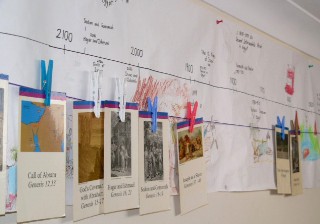
The best way to teach the history of the world with homeschool curriculum is to choose homeschool history resources that move through the study of world history in a chronological manner and use an integrated approach.
This means that whatever way you decide to teach history, you will start at the beginning and move to the present day. 'Chronos' means Time in Greek, so when we think of chronology, we think of time-lines, sequence, order, beginning, moving from B.C. to A.D.
- History of the world homeschool curriculum
- World history spine books
- World history reference books - for an overview of world history
- Why teach world history chronologically in your homeschool?
- Homeschool history curriculum ideas - ways to teach world history across the 12 years of homeschooling
- Hands-on lapbooks across world history from Schoolhouseteachers.
History of the world homeschool curriculum
Here is a list of homeschool history curriculum which covers world history.
Story of the World
Four volumes covering the history of the world. Narrative text, Audio CD, Activity Book with narration ideas, project ideas, maps and suggested history living books.
- The Story of the World; Volume 1 - The Ancients 5000 BC to 400 AD
- The Story of the World; Volume 2 - The Middle Ages (400 - 1600)
- The Story of the World; Volume 3 - Early Modern Ages (1600-1850)
- The Story of the World; Volume 4 - The Modern Age
Veritas Press
Includes 36 weeks lessons, 32 flashcards, teacher's manual, worksheets, projects, reading, maps, enhanced CD
Tapestry of Grace
12 subjects for years K-12. Structured in a 4 year cycle, reading assignments, teacher's notes, project ideas, timelines, maps, comprehensive curriculum, also has online components
Mystery of History
Classical Christian approach for all ages; emphasizes reading, writing and research; chronological
Heart of Wisdom
Bible based homeschooling; methods, programs and resources where students spend half the day studying God's Word and the other half of the day studying God's world.
Time Travelers
Huge range of unit studies across time periods of world history; includes living book recommendations; lapbooks, notebooking
Sonlight History
Integrates world history, readers, read aloud books and Bible; language arts, science curriculum also available to create a K-12 complete curriculum; 18 core packages.
TruthQuest History Curriculum
Compendium of living books, picture books, arranged in subject and grade level; excellent commentary / thread analyzing the questions, "Who is God?" "Who, then is mankind?" Years 1-12
Trisms
Chronological study of world history with geographical progression for middle and high school history; promotes personalized independent study through questionaires, timelines and literature assignments.
History of the world curriculum spine books
A history spine book can be used to teach world history and can be used to tie the stories of history together. It may even be a textbook which moves in a chronological way. Here are some spinebooks.
Listed below are some spinebooks and this page lists homeschool history spinebooks across world history time periods.
- The Greenleaf Guides - across world history
- Story of the World - 4 volumes
- Diana Waring Curriculum
- The Story of ..... by H.A.Guerber
- Streams of Civilization - 2 volumes
World history reference books for your homeschool
The easiest way to teach world history in a chronological approach is for ALL the children to study the same time period at the same time, but at different levels-focussing on the same events and characters (mostly), but studying them in varying degrees of depth.


There are wonderful history resources to teach the history of the world chronologically.
One is the The Timetables of History which is an amazing book which goes through the each year chronologically and lists the History/Politics; Literature/Theatre; Religion/Philosophy; Visual Arts; Music; Science/Technology; Daily Life. It links people, events and what is happening across world history year by year.
The other favourite of ours is the The Timechart History of the World which folds out to be an amazing time-line. So much details and so visual. Something which comes out again and again!
Is it important to teach history chronologically?
There would be some who argue that you must study world history in a chronological way for the child to have an understanding of how everything fits together. I agree that at some time in the child's education, they should see the big picture and have a clear understanding of the scope of history and the time-periods. This can be done by using a chronological approach to history. However, I think that you could choose to keep the study of history to interest-driven thematic units for primary years or for a few years at least, and then pursue a chronological study of history.
So, in short, I agree that studying world history chronologically makes sense, but at the same time, you will not ruin their education if you teach history using some thematic unit studies.
History of the world homeschool ideas for K-12
One way to teach the history of the world in your homeschool is to use unit studies across the years teaching the history of the world three times during the 12 years of homeschooling.
Homeschool History Unit Studies - years K-12
SchoolhouseTeachers have an extensive set of world history courses - for all ages - elementary, middle school and high school history courses. Here are 3 examples of courses focussing on different age groups.
Homeschool Elementary History: Year 1-4: Thematic Units- based on interests; Develop a love for history and reading while you focus on their character development.
Homeschool History Curriculum Middle School - Years 5-8: Chronological Study- once through history- focusing on events/characters/wars/making some connections. Use these free notebooking pages for history.
Homeschool History Curriculum High School - Years 9-12: Chronological Study- second time through historical time periods -focusing on making connections- the how and why of history; evaluating history; reading primary sources; reading philosophers of the time-period; reading the Great Books;
Teaching History - 2 times in 12 years
Another way to approach homeschool history is to teach world history twice within the 12 years of homeschooling:
Years 1-6: Chronological Study of History- once through all the historical time periods; Focusing on events, characters, wars, famous men and women, cultures, and so on. This is the time to strengthen their love of history, and reading, as you primarily work on their character development.
Year 7-12: Chronological Study of History- second time through all the historical time periods; Focus shifts from factual events and stories to the how and why; Making connections of how the belief system of a culture is related to the actions of the people at the time; why wars happened; moving to philosophical readings and evaluating them against scripture. Discussion is crucial at this point to develop critical thinking and analysis.
Teaching History - 3 times in 12 years
Other homeschool families prefer to teach world history 3 times within the 12 years of homeschooling. This is more in line with the classical approach using the 3 stages of learning: grammar, logic and rhetoric stages.
Years 1-4: Chronological study of history- once through all the historical time-periods. Enjoy the stories and give a general overview; Get the general picture. The main focus of this young age is character development and all of their studies can be the vehicle used to help us train them in obedience, persistence and diligent work habits.
Years 5-8: Chronological study - second time: more in depth study; re-visit the time-periods again, focus can be more in depth; Begin making connections.
Years 9-12: Third time of chronological study through history: The goals are to teach this age group to think clearly about events, philosophies, characters in light of the Bible. The three tools are reading, writing and thinking. More in depth discussion.
Having created a love of History, one may consider using the interest, building upon it, researching and writing about it! Make history come alive with history days and living books history.
If you're interested in lapbooking - Schoolhouseteachers have a wonderful homeschool history course of lapbooking through the ages.
Hands on projects and lapbooking
From ancient civilizations to World Wars I and II, Lapbooking Through the Ages introduces your homeschool history students (grades 1-6) to everything from spies and espionage to the history of toilets through time! From silly to serious, this homeschool history series explores history in an engaging, hands-on way that is designed to keep your children creating and learning.
These are excellent hands-on themed lapbooks which can be added to any homeschool history curriculum, across historical themes and ages.
- Ancient Egypt
- Ancient Greece
- Ancient Rome
- China
- Castles and Knights
- Countries of the World
- Spies and Espionage
- The Queen
- The Titanic
- Toilets Through Time
- Victorians
- World War I
- World War II

Where to from here?
- Homeschool History Curriculum Page
- Visit the Homeschool History Bookshop
- Teach Homeschool History Using a Spine Book can help you organize your study in a chronological way.
- Use these free notebooking pages to tie in with the Famous Men Spinebook
- You can also teach history Using a Unit Study Approach
- Using Living Books to teach homeschool history
- My TOP TEN Living Books in History

Schoolhouse Teachers
Schoolhouse Teachers History